
Latest Products


Contact Us
- Floor 3, Building B, Beicang Building, Haiguan Road, Zhangjiagang City, Jiangsu, China.
- sales05@maxxtools.com.cn
- sales01@maxxtools.com.cn
- sales03@maxxtools.com.cn
- sales04@maxxtools.com.cn
- +86-512-58689066

VDE Test Pen
The VDE test pen is a tool used to detect voltage. It is portable, safe and reliable, and is widely used in electricians, electronic maintenance and other fields. The cutter head of VDE test pen is made of 6150CRV, the alloy cutter bar is strong and durable, and the thickened and highly translucent handle is beautiful and durable. The tip of the shaft blade is slotted and can be used as a screwdriver.
Description
Rich Experience
In over 15 years history of supplying high quality product for our client, Maxxtools has gradually become the most reliable supplier of many famous tools importers.
Excellent Product Quality
Concentrates on hand tools and labor supplies. It provides over 1000 different kinds of products to worldwide.
Excellent Customer Service
Send the inquiry to our website, and the e-commerce operator will assign it to the corresponding sales according to the content of the inquiry. Sales contact with customers via email, understand their specific needs.
The VDE test pen is a tool used to detect voltage. It is portable, safe and reliable, and is widely used in electricians, electronic maintenance and other fields. The cutter head of VDE test pen is made of 6150CRV, the alloy cutter bar is strong and durable, and the thickened and highly translucent handle is beautiful and durable. The tip of the shaft blade is slotted and can be used as a screwdriver.

Torx screwdriver features a star-shaped head with six circular lobes or points. In other words, it looks like a star with six points that are slightly rounded. This type of screwdriver head is ideal for applications that require high-speed screwing without the risk of the screw head slipping or stripping.

VDE Slim Pozidriv Screwdrivers
The Phillips head screwdriver and pozidriv screwdriver are comparable. Nevertheless, it has two crosses that contact one another rather than just one. Put differently, what you have here is a 45-degree-angled cross and a cross that is centered. From the visual perspective, it resembles a plus sign with an X through it.

VDE Slim Phillips Screwdrivers
A screwdriver is a handheld tool used for turning screws. It consists of a handle and a shaft, with various tip types (e.g., slotted, Phillips, Pozidriv, Torx, Hex) to fit different screw heads. Screwdrivers are essential in DIY projects, electronics, and carpentry, making them a versatile and indispensable tool.

A screwdriver is a commonly used tool that is used to screw screws into place. Each screwdriver has a thin wedge-shaped head that can be inserted into the slots or notches of the screw heads. Rotate clockwise to tighten and counterclockwise to loosen. Screwdrivers include slotted screwdrivers, Phillips screwdrivers, pozidriv screwdrivers, torx screwdrivers, hex screwdrivers, etc. The head of a slotted screwdriver is flat.
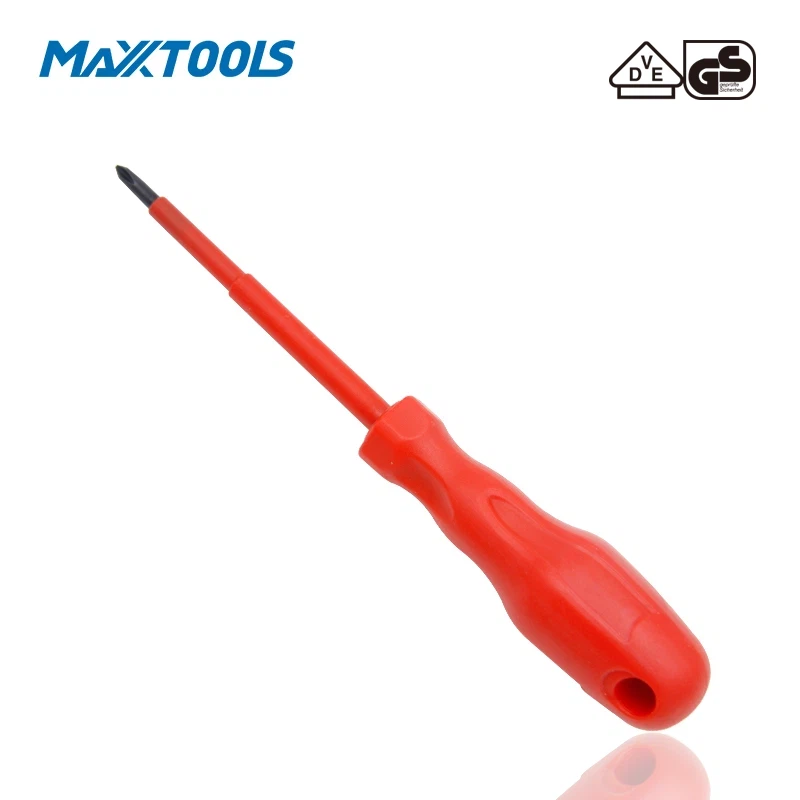
The specifications of the Pozidriv screwdriver are generally represented by PZ numbers. Common specifications include PZ0, PZ1, PZ2, PZ3, etc. The Pozidriv screwdriver is an upgraded version of the Phillips screwdriver, which can withstand greater torque and is not prone to slipping. The corresponding cutter holder diameters of PZ0-PZ3 are the same as the cross, which are 3mm, 4.5 or 5mm, 6mm, and 8mm respectively.

The VDE Phillips screwdriver is made of chromium vanadium steel or S2 steel. The blade is blackened and magnetized, making it highly corrosion-resistant and can easily pick up small screws, improving the user's work efficiency. The outer layer of the tool holder is covered with rubber, and the handles are available in two options: single-color PP hard handle and two-color soft handle.

A screwdriver is a common tool used to turn screws into place. Every screwdriver has a thin wedge-shaped head that can be inserted into the slot or notch of the screw head.

Neon bulb test pens, also known as electric pens, are used to verify whether wires, appliances, and metal casings of electrical equipment are energized.
Electrical Safety
One of the primary advantages of VDE test pens is their contribution to electrical safety. These tools are designed with insulated handles and probes, which help protect the user from electric shock by minimizing the risk of accidental contact with live electrical components.
Non-Contact Voltage Detection
VDE test pens are typically non-contact voltage detectors, meaning they can detect the presence of voltage without the need for direct contact with the electrical circuit or equipment. This feature enhances safety by reducing the potential for accidental short circuits or electrical shocks.
Versatility
VDE test pens are versatile tools suitable for a wide range of applications. They can be used to detect voltage in various electrical systems, including residential, commercial, and industrial settings. They are commonly used by electricians, technicians, and DIY enthusiasts for tasks such as circuit testing, outlet testing, and equipment troubleshooting.
Durability and Reliability
VDE test pens are built with durability and reliability in mind. They are constructed using quality materials that withstand regular use in demanding environments. Additionally, they often feature built-in overload protection mechanisms that help safeguard the test pen from damage caused by high voltage or current spikes.
Compliance with Safety Standards
VDE test pens are designed to comply with safety standards and regulations, such as those set by the Association for Electrical, Electronic & Information Technologies (VDE) in Germany. This compliance ensures that the test pens meet specific safety requirements and provide reliable performance.
Application of VDE Test Pen
Measuring voltage with a VDE test pen is the most common method for VDE test pens. However, it should be noted that the electric test pen can only measure the presence or absence of voltage in the circuit, and cannot judge whether the circuit is on or off or the magnitude of the voltage (with voltage, it must be a circuit, but without voltage, it may not be an open circuit). When measuring, touch the tested line with the electric test pen, if the electric test pen lights up, it proves that there is voltage in the line; otherwise, there is no voltage. Before measuring, we must first know the purpose of our measurement. For example, in a single-phase circuit, the live wire has voltage under normal circumstances, and the neutral wire and ground wire have no voltage. Therefore, under normal circumstances, the live wire can light up the electric pen, but the neutral ground wire cannot light up. But when we measure the zero ground wire and the electric pen cannot be lit, it does not mean that the zero ground wire is completely normal, and further testing is required.
Distinguishing between neutral and ground wires has always been a headache for many beginner electricians. But in fact, a test pen can solve this problem. Afterwards, hold an electric pen in each of the left and right hands, and the measurer stands on an insulating object, not in contact with the ground. Use one of the electric pens to touch the live wire, and the other electric pen to touch the line to be tested. If the two electric pens are not lit or the brightness is low at this time, the wire to be tested is the ground wire. If the two electric pens light up normally at this time, the line to be tested is the zero line.
Is the circuit alternating current or direct current? The same can be solved with a pencil.
Method 1: There are at least two wires in the circuit, measure with an electric pen, if one of the two wires can light up the electric pen, and the rest cannot light up, it proves that the circuit is AC. If there are two wires that can light up the VDE test pen, it proves that the circuit is direct current.
Method 2: When the circuit is AC, the brightness of the electric pen is higher. When the line is DC, the brightness of the electric pen is low.
Method 3: Observe the light-emitting position of the electric pen. The same is to use the electric pen to touch the live wire. If it is direct current, the neon bulb inside the electric pen will only emit light at one end; if it is alternating current, the neon bulb inside the electric pen will light up. Methods as below:
First, use an electric pen to measure the several wires in front of you. Only one wire can light up the electric pen, and this wire is the live wire.
By observing the light-emitting position of the neon bulb, it is also possible to know the positive and negative poles of the direct current at the same time.
As mentioned above, in direct current, neon bulbs only emit light at one end. If the neon bulb emits light at one end of the pen tip, the measured position is the positive pole of the power supply; otherwise, it is the negative pole of the power supply.
Structure of VDE Test Pen
A threaded metallic cap is at the top of the VDE test pen holding the circuit inside. The cap needs to be grounded when the metallic rod is inserted in the plug. The power socket is analogous to the positive terminal of a battery. Just like in the case of a battery we need to connect the other end of the circuit to the negative terminal where the current sinks in, we need a sink for the current from the power source too. The ground acts as that sink in this case. Most of the time, the user forms the link to ground for the circuit which is created when rod is inserted in the power source. The user does not get any kind of shock because there is already current limiting resistors in the testers and also because a dry human body has very large electrical resistance.
Why Don't We Get an Electric Shock While Using a VDE Test Pen for Checking Current in a Live Phase?
When using a VDE test pen to check current in a live phase, you typically do not get an electric shock because the VDE test pen used for this purpose is designed to have a very high impedance. VDE test pens used for checking current in live circuits are generally called non-contact voltage VDE test pens or voltage detectors.
These VDE test pens work by detecting the electric field around a live conductor without actually making physical contact with the conductor. The high impedance of these VDE test pens means that they draw very little current from the circuit being tested, which is why you do not feel a shock when using them. The high impedance of the VDE test pen prevents a significant amount of current from flowing through the VDE test pen and into your body, thus keeping you safe from electric shocks.
It is important to note that while these VDE test pens are designed to minimize the risk of electric shock, they are not foolproof. It is still crucial to follow proper safety procedures when working with electricity, such as wearing appropriate personal protective equipment and ensuring that you are properly trained in using the testing equipment.
Difference Between VDE Test Pen and Multimeter
Function
A non-contact VDE test pen solely determines whether the voltage is present, in contrast to a multimeter, which may also measure current. The voltage level on the cable can be measured with a multimeter, among other measurements and tests.
Working
To check if two points are linked, a multimeter search for very low resistance. To accomplish so, a tiny current is introduced into the circuit, and the potential difference across those locations is measured thereafter. The resistance is then determined using the voltage drop. Two wire connections with a metal probe at either end make up a straightforward neon VDE test pen. The wire probes must make contact with the cables; one probe should be in contact with the hot wire and the other should be with the neutral wire. The neon bulb will illuminate if there is current flowing through it.
Safety
In order to attach a multimeter to the circuit in series, the connection must first be broken. It is a somewhat drawn-out procedure that has to be handled carefully. If handled by amateur electricians, it might be a little dangerous to use. The simplest and safest voltage testing instrument is a basic, battery-powered VDE test pen, especially a non-contact VDE test pen. It enables voltage testing without requiring you to touch any cables or circuitry components.
Safety Factors to Consider When Using VDE Test Pen
Wear Proper Safety Gear
Always wear appropriate personal protective equipment (PPE), including safety glasses, gloves, and protective clothing, to shield yourself from electrical hazards and potential shocks.
Environmental Hazards
Consider environmental factors, such as tight workspaces, the presence of flammable materials, or wet conditions, which can pose additional risks. Adapt your safety measures accordingly.
Lockout/Tagout Procedures
Implement lockout/tagout procedures to isolate and secure the power source. This prevents accidental re-energization while you work on the circuit or equipment.
Test Before You Touch
Use a non-contact voltage tester or a test instrument to confirm the absence of voltage before touching any electrical components. This helps ensure that you're working on a de-energized system.
Proper Training
Ensure that anyone using VDE test pens is adequately trained in their use. Understanding the equipment and its limitations is vital for safe testing.
De-Energize the Circuit
Whenever possible, de-energize the circuit or equipment you're testing. Ensure it's disconnected from the power source before performing any electrical tests.
The Correct Way To Hold And Use The VDE Test Pen
The correct way to hold the low-voltage VDE test pen
Commonly used low-voltage VDE test pens, master the two-grip method of testing. A pen-style tester, the metal clip is pressed against the palm of the hand. Thumb index finger and middle finger, pinch the middle of the electric pen barrel. Rotary chisel-type electric measuring pen, the index finger presses the tail metal cap. With the thumb, middle finger and ring finger, pinch the middle of the plastic rod. The small window of the neon tube is backlit, and you can observe it by facing yourself.
Things to know when using a low-voltage VDE test pen
When using a low-voltage tester, you should know that there should be eight items. With a ballpoint pen VDE test pencil, pinch the rod with a metal hoop. Carefully inspect the assembly inside the electric pen, the resistor must be behind the neon tube. Regularly test the resistance value, it must be greater than one megohm. Rotary chisel type measuring pencil, the chisel rod is covered with an insulating tube. Before use, there is a forecast at the power station to check whether the performance is good.
The VDE test pen distinguishes AC and DC
The electric pen measures AC and DC, AC is bright and DC is dark. The whole body of the AC neon tube is bright, and the side of the DC neon tube is bright.
The electric measuring pen distinguishes the positive pole and the negative pole of the direct current
To judge the positive and negative poles of DC, look carefully at the neon tube of the electric pen. The bright front end is the negative pole, and the bright rear end is the positive pole.
Test and judge the positive and negative grounding of the DC system with the electric VDE test pen
In the DC system of the substation, the electric pen does not light up when touched. If the light is near the tip of the pen, there is a ground fault on the positive terminal. If the light is close to the handle, the ground fault is at the negative pole.
Use the VDE test pen to judge whether any two wires in the AC circuit are in phase or out of phase
To judge whether the two wires are the same or different, hold an electric pen in each hand, insulate the two feet from the ground, touch a wire with each pen, and look at a pen with two eyes.
The global VDE test pen market is witnessing several emerging trends. One of the key trends is the increasing adoption of smart VDE test pens equipped with advanced features such as non-contact voltage detection and built-in LED lights. These pens can accurately detect live wires and provide visual and audible alerts, enhancing safety for users. Another trend is the integration of VDE test pens with mobile applications, enabling remote monitoring and control. Additionally, manufacturers are focusing on miniaturization and enhanced durability of these pens, making them more portable and suitable for various applications in industries such as construction, electrical, and automotive.

Tips for Maintaining Your VDE Test Pen
Maintaining the integrity and functionality of your VDE test pen is essential for ensuring its longevity and reliability. A fundamental aspect of maintenance is to regularly inspect the pen for any physical damage, such as cracks or loose components, which could impair its performance. Careful handling is advised to prevent drops or impacts that might damage the internal mechanisms or the pen's sensitivity to electrical currents.
Proper storage plays a vital role in preserving your VDE test pen. Choose a location that is free from excessive moisture and temperature fluctuations. A protective case or designated compartment within your toolbox can prevent accidental damage and keep the pen away from harmful conditions.
Battery care is another crucial element of pen maintenance. Even though it might seem minor, ensuring that the batteries are not only functional but also fresh, can significantly impact the accuracy of your pen's readings. It's advisable to check the battery level regularly and replace them as needed to avoid any interruptions during electrical testing. For models that include a battery status indicator, make the most of this feature to preemptively manage battery replacements.
Additionally, keeping the pen clean is essential. Dust, dirt, and other particulates can accumulate on the pen, potentially interfering with its operation. Wipe the pen down with a dry, soft cloth after use to remove any debris. Avoid using harsh chemicals or water for cleaning, as these can damage the pen's components or compromise its electrical integrity.
Our Factory
Maxxtools Co.,Ltd was established in 2005 and concentrates on hand tools and labor supplies. It provides over 1000 different kinds of products to worldwide professionals who demand superior performance and durability on the job.In over 15 years history of supplying high quality product for our client, Maxxtools has gradually become the most reliable supplier of many famous tools importers, whosalers and retailers.

Ultimate FAQ Guide to VDE Test Pen
Hot Tags: vde test pen, China vde test pen manufacturers, suppliers, factory, insulated screwdriver punches, insulated screwdriver guard, insulated screwdriver for hvac work, insulated screwdriver lubricants, flexible shaft insulated screwdrivers, insulated torx screwdriver
You Might Also Like


