
Latest Products



Contact Us
- Floor 3, Building B, Beicang Building, Haiguan Road, Zhangjiagang City, Jiangsu, China.
- sales05@maxxtools.com.cn
- sales01@maxxtools.com.cn
- sales03@maxxtools.com.cn
- sales04@maxxtools.com.cn
- +86-512-58689066
Rich Experience
In over 15 years history of supplying high quality product for our client, Maxxtools has gradually become the most reliable supplier of many famous tools importers.
Excellent Product Quality
Concentrates on hand tools and labor supplies. It provides over 1000 different kinds of products to worldwide.
Excellent Customer Service
Send the inquiry to our website, and the e-commerce operator will assign it to the corresponding sales according to the content of the inquiry. Sales contact with customers via email, understand their specific needs.
Insulated Pliers are tools that can pinch, grip, cut, bend, etc., with the tip of the tool. By sliding the joint in the middle, it can be adjusted according to the thickness and size of the object to be pinched. There are many types of pliers, and each one is good at different tasks. There are general combination pliers, tongue-and-groove pliers with a large range of movement of the jaw, vise pliers that can pinch and fix objects, and split ring pliers that are excellent for handling ring-shaped metal fittings. The material is plastic and covers the entire tool or grip area. It is mainly used for electrical work where there is a risk of electric shock. It has various features, such as one with excellent abrasion resistance, one with high electrical safety, and one with a secure grip and high fit.
 VDE Wire Stripper
A VDE wire stripper is a small hand-held tool that is used to remove the insulation from electric wires. These portable hand-held tools are extremely popular among electricians and even DIYers for
Add to Inquiry VDE High Leverage Diagonal Cutting Pliers
The jaw hardness of diagonal cutting pliers can reach 55HRC-62HRC, and the shearing force is strong.
Add to Inquiry VDE High Leverage Long Nose Pliers
Long nose pliers are very versatile. In the field of mechanical repair and manufacturing, long nose pliers can be used to install and remove mechanical parts such as screws
Add to Inquiry VDE High Leverage Combination Pliers
Combination pliers have a large clamping force and can firmly clamp various materials, such as steel wires, wires, pipes, etc. The cutting edge of the wire cutter adopts a special cutting edge design
Add to Inquiry VDE Waterpump Pliers with Dipping Handle
Water pump pliers are generally used to clamp flat or cylindrical metal parts. It features multiple jaw opening widths.
Add to Inquiry VDE Cable Shears with Dipping Handle
Cable shears are type of clippers specifically designed to cut electrical cables. The two blades interlock and can be opened and closed.
Add to Inquiry-
VDE Wire Stripper with Dipping Handle
One of the instruments that instrumentation electricians, internal line electricians, and motor repairers frequently use to remove the wire head's surface insulation layer from the power source is a
Add to Inquiry  VDE Flat Nose Pliers with Dipping Handle
Flat-nosed pliers are a commonly used hardware tool. It has a flat mouth with non-slip functional teeth on the inside of the jaws and no cutting edge.
Add to Inquiry VDE Round Nose Pliers with Dipping Handle
Round-nosed pliers are pliers with rounded edges on the jaws. They don’t have cutting edges and they are commonly used to make round splices or loops of wire.
Add to Inquiry VDE Bent Nose Pliers with Dipping Handle
Bent nose pliers are a type of pliers with a curved jaw that is commonly used to clamp and bend metal materials.
Add to Inquiry VDE Diagonal Cutting Pliers with Dipping Handle
Diagonal pliers are versatile and usually have a cutting edge on one side that can be used to cut wire. Whether it's cutting wires, wires, ropes
Add to Inquiry VDE Long Nose Pliers with Dipping Handle
Long nose pliers are a common hand tool used to grip small or hard-to-grasp items. The jaw of long nose pliers is usually tapered and can hold very small items such as small screws, small nuts
Add to Inquiry
Insulated Handles
The most distinctive feature is the insulated handles, usually made of materials such as rubber or plastic. This insulation prevents the conduction of electricity through the handles to the user's hand.
Dual Material Construction
Some insulated pliers have a dual-material construction, with a hard outer layer for durability and a softer inner layer for comfort and improved grip.
Tested and Certified
Quality insulated pliers are often tested and certified to meet safety standards. Look for tools that comply with relevant industry regulations to ensure they provide adequate protection.
Variety of Types
Insulated pliers come in various types, including needle-nose pliers, lineman's pliers, side-cutting pliers, and more. The specific type you choose depends on the task at hand.
Color Coding
Some manufacturers use color-coding on the handles to indicate the level of insulation and the maximum voltage they can safely handle. This helps users quickly identify the right tool for a particular job.
Types of Insulated Pliers
Combination pliers, also known as lineman's pliers, are used mainly by electricians to bend, grip, twist, and cut wires and cables. Made of hardened steel with insulated handles, these pliers have rounded jaws for bending wire and a cutting edge for snipping it. Their squared-off, serrated nose provides a secure grip. They're used mostly in electrical work, like installing and repairing wiring systems, and in telecommunications and network engineering.
Needle nose pliers, also known as long nose pliers, are primarily used for precise tasks that require a high level of detail, including bending, re-positioning, and snipping wires. The long, thin jaws are perfect for reaching into tight spaces where other pliers might not fit. They are often used in electrical work, jewelry making, and crafting due to their precision and versatility. The pliers are typically made of sturdy steel and have insulated handles for safety. In addition, they usually have a cutting edge near the base of the jaws for cutting and trimming wire.
Angled needle nose pliers have elongated, slender jaws angled at the end, typically around 45 to 90°. The angled tip allows users to work around obstructive objects and perform tasks at odd angles.
Cutting pliers, also known as diagonal pliers or wire cutters, are commonly used for cutting wire, nails, and other materials. They have a sharp edge and a pivot near the cutting edge, providing the leverage needed for cutting through tough materials. Cutting pliers are used in electrical work, jewelry making, and various types of assembly or repair work. The tool is typically made of high-quality steel to withstand the stress of cutting, and the handles are usually insulated for safety. The sharp, angled head allows the user to cut close to flat surfaces and in tight spaces.
Wire stripping pliers are specialized tools for stripping the insulation from electric wires. They have a series of holes or notches of varying sizes that correspond to different wire gauges. The user inserts the wire into the appropriate hole and pulls, which removes the insulation without damaging the wire underneath. These pliers are most commonly used in electrical work, particularly in tasks involving the installation, repair, or modification of wiring systems. In addition to stripping, many wire stripping pliers also have cutting and crimping capabilities, making them versatile tools for electricians, technicians, and DIY enthusiasts.
Electrical installation pliers are a multi-functional tool designed specifically for electrical work. They combine several functions, including cutting, stripping, bending, and gripping, making them useful in various electrical tasks. The cutting edge is used for cutting wires and cables, while the stripping notches are strip insulation from wires of different gauges. The round jaw is for bending wire, and the serrated gripping surface allows for a firm hold on various materials. Electrical installation pliers are commonly used in tasks involving the installation, maintenance, and repair of electrical and telecommunications wiring.
Application of Insulated Pliers
GrippingUses of Insulated Pliers
The primary use of insulated pliers is for gripping. You can use them to loosen or tighten bolts, grip objects for stability, or pull out pins, nails, or other fasteners. For example, slip joint insulated pliers are a utility insulated pliers designed for gripping and transmitting torque. They have relatively flat jaws with teeth for gripping small objects and a rounded, toothed opening for gripping larger objects, such as bolt heads and nuts.
Bending/Straightening
The insulated pliers can also be used for bending or straightening. The cross brace of insulated pliers gives them superb torque power to bend and twist objects such as sheet metal, nails and wires. All insulated pliers can help bend things, so the kind you choose depends largely on the specific object you need to bend. Long-nose insulated pliers or needle-nose insulated pliers help you grip small objects that may be difficult to reach. Electricians usually use lineman's insulated pliers to bend wires and cables.
Cutting
Some insulated pliers can also cut wires and nails. Diagonal cutting insulated pliers and side-cutting insulated pliers, often called wire cutters, are primarily used to cut and sever wires. In most cases, their jaw construction makes wire cutters less suitable for gripping large objects, such as bolts. However, they are still considered insulated pliers because of their ability to effectively grip and remove nails.
Splicing Wires/Stripping Insulation
Electricians use a variety of insulated pliers to splice wires and strip insulation. For this task, lineman's insulated pliers are a popular choice. Using the wire cutter feature, you can cut through the insulation of one wire and strip off a small section to reveal the bare wire inside. If you do the same thing to another wire, you can use the insulated pliers to help join or splice the two wires together.
Implementing Insulated Pliers: Safe and Effective Application Techniques

Acting as vital instruments across a broad range of industries including electronics and construction, Insulated pliers are commonly used to execute tasks such as twisting, pulling, or cutting. In scenarios where electrical shock is a potential hazard, these instruments play a critical role in reinforcing safety. The risk involved in such incidents is notably diminished owing to their use. Ensuring that all metal constituents of the pliers are encased is crucial, keeping the users hands secure with grips distanced from any metallic elements. This precautionary measure offers enhanced safeguarding from possible electrical shocks.
Forged from superlative German chromium-molybdenum-vanadium (CMV) steel, the power and lasting performance of insulated combination pliers exceed professional craftsmanship requirements. Featuring toothed jaws and a quad-point grip orifice, these tools ensure a firm grip that minimizes potential slipping when handling cables and parts, significantly enhancing safety during operations. Its featherweight framework makes these pliers approximately 20% lighter than alternate models, facilitating user comfort over extended periods.
Furthermore, some pliers are precisely constructed with a slim contour, allowing advanced accessibility in cramped areas to improve output in complex wiring frameworks. The groundbreaking construct of the insulated pliers not only boosts ergonomic factors but also influences their effortless function across numerous electrical and support duties. An amalgamation of superior lightweight structure, amplified resilience of materials, and niche features renders insulated pliers a crucial instrument for professionals engaged in electrical, maintenance, and construction sectors.
Dos and Don'ts When Using Insulated Pliers
Use the right size insulated pliers for your hand and personal comfort. Using the wrong size can make it difficult to operate or cause you to drop the tool leading to injuries like pinched hands or fingers.
Never use insulated pliers as a hammer. The insulated pliers can crack and break, or the edges may become damaged.
Avoid exposing insulated pliers to excessive heat. Heat can alter the material properties and damage the tool.
Don’t use insulated pliers to tighten nuts or bolts. A wrench is better and can perform the job without risking damaging the fastener.
Always use insulated insulated pliers when working near live wires or parts to help protect against arc flash and other hazards. Non-insulated handles can be confused with insulated ones. You can ensure your tools comply with National Fire Protection (NFPA), International Electrotechnical Commission (IEC), ASTM and DIN standards by looking for a double triangle symbol or the VDE logo.
Never use insulated pliers for cutting hardened wire unless they are specifically manufactured for this purpose. Using the tips to bend a large wire can damage some types, like long-nose insulated pliers.
Always cut at right angles when using insulated pliers. Never bend the wire back or rock back and forth against the cutting edges. Ensure the cutting edges on insulated pliers are sharp since dull or worn-down edges can require significantly more cutting force.
Never extend the length of the insulated plier handles to create more leverage. Instead, use a larger pair of insulated pliers or a bolt cutter depending on the task.
Remember to oil your insulated pliers occasionally. Place a drop of oil at the joint to help ensure effortless operation and increase the life of your tool.
Always wear safety glasses or goggles to help protect your eyes when cutting wire.
At face value, pliers with insulated handles look very similar to those with comfort grip handles. They are both beefy and very comfortable in your hands. What sets the insulated handles apart is the protection they provide against electric shock, up to a known threshold. In contrast, pliers with purely ergonomic handles also provide some electrical insulation but their threshold is unknown. That is why they don’t fall into the category of pliers with insulated handles. Emerging capabilities of enhanced insulated pliers serve as a response to market demand, offering more than their traditional clasp and severing functions. Certain models of these pliers possess integrated wire snippers, facilitating wire cutting for users, negating the need to switch tools. The structure of the plier's clamping end commands attention due to its superior bite and holding power, demonstrating its indispensable worth when dealing with twisting, pulling, or retaining hard-to-reach items.
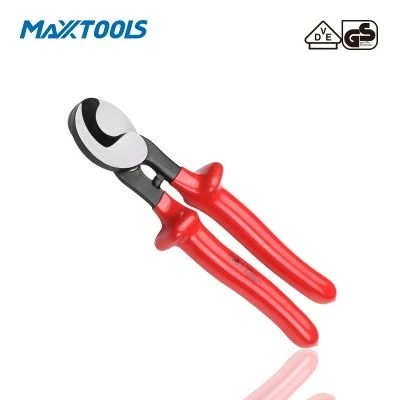
Tailored to match sector requirements, the functions of upgraded insulated pliers have transformed, offering more than their fundamental gripping and shearing functions. Some models of such pliers come equipped with incorporated wire slicers, allowing users to sever wires without the need for multiple tools. The architecture of the plier's pinchers plays a pivotal role, crafted to deliver maximum grip and clasping force, proving beyond valuable in situations like holding, wrenching, or retrieving hard-to-reach objects. Insulated pliers, engineered with in-built safety mechanisms to secure users in risky situations, yield substantial benefits. These specialized instruments not only guarantee operator safety but also augment proficiency in an array of tasks, combining many actions into a singular instrument. A significant advantage of insulated pliers is their resilience, derived from incorporating superior materials that resist wear and degradation. This resilience is further highlighted by manufacturers who frequently offer a confined lifetime guarantee owing to the sturdy construct of these pliers. Moreover, insulated pliers are devised to deliver unrivalled performance in electrical tasks, ensuring prevention of electrical shocks and providing security that tasks are performed efficiently and safely. Their design caters to experts who put safety and dependability at the forefront in their job, marking insulated pliers as a non-negotiable tool in various sectors.
How to Tell if Pliers Are Insulated
Visual Inspection
You can make a couple of visual observations on pliers to tell if they are designed for use in an electrified environment. They include reading the stamped voltage rating and certifications, observing the design of the handles, and checking the integrity of the insulation material.
Maximum Voltage Rating
As mentioned above, the first observation you can make is to read out the voltage value stamped on the handles. This is the dielectric voltage or the breakdown voltage rating. It is the voltage above which insulated pliers lose their insulation property. Typically, most insulated pliers are rated 1000V AC and 1500V DC.
Quality Assurance Markings
Besides the breakdown voltage, other things you will see stamped on the handles of insulated pliers are various markings for the quality assurance tests the pliers have passed. Typically, you will see stamps such as VDE, GS, UL, IEC 60900, and ASTM F1505. For instance, VDE and GS are European marks of safety for electro-technical products. On the other hand, the UL marking shows that a product has undergone all applicable tests. IEC 60900 is the international standard for insulating tools for working in live or close to live parts of nominal voltages of 1000V AC or 1500V DC.
Handle Design
Another way to easily tell that pliers are insulated is to look at the handles. Although insulated pliers have chunky handles just like regular pliers with comfort grip handles, they have larger handle guards. The guards protect your hand from slipping to the metallic part. So, even though rubber handle pliers may have guard rails on the handles, the rails are significantly smaller than those of insulated pliers.
Color Coded Insulation Material
Another notable difference between insulated pliers and regular pliers is the double layer color-coded handle grips. The handles of insulated pliers are dual-layered and each layer has a different color. Typically, the upper layer is red or orange and the inner layer is yellow or white but you can find other colors too. For example, Klein insulated pliers have orange and black layers. Besides adding to the thickness of the handles, the inner insulation layer acts as a warning to tell you when the insulation is compromised. So, if the handles of insulated pliers are damaged such that the inner layer is exposed, those pliers are not safe anymore. You cannot use them around live lines or equipment.
No Spring Mechanism
When buying pliers, most people prefer those with a spring mechanism because they minimize hand fatigue. The spring keeps the jaws open so that you don’t have to manually push the handles to open the jaws. This is different for insulated pliers. Insulated pliers are hardly spring loaded. And those that have a spring mechanism, it is a plastic spring. The reason for this is to avoid the dangers that may occur if a spring-loaded pliers breaks down and the metallic spring falls into the live parts of an equipment and shorts things up causing problems.
Other than the visual properties that are easy to spot off the bat, insulated pliers have unique electrical properties. So, you may want to take your inspection further to perform an electrical test on the handles to determine the actual dielectric breakdown voltage. This might be helpful when working on circuits that are capable of having higher voltage spikes than the pliers rating. Sometimes the urge to do an electrical test on insulated pliers may just be out of curiosity. You know some manufacturers claim that their insulated pliers exceed specific electrical standards and you may be tempted to test the claim. This is the test you would perform. The electrical test you can perform on the handles is known as the insulation resistance test. You use a device called an insulation tester or megometer. The device measures high resistance values by sending a high dc voltage signal into an object. So, to measure the resistance of the handle insulation material, you connect one of the leads to the jaw and the other to the insulation. Then inject a DC voltage through the jaw (start with 500V DC) and the test leads will measure the resulting resistance. If the pliers are safe, you should read a very high resistance value in the range of 1000s of megaohms. However, as you increase the test voltage, you may notice the insulation resistance value decreasing. This means that insulated pliers become less safe as the voltage increases above the threshold or breakdown voltage.
Our Factory
Maxxtools Co.,Ltd was established in 2005 and concentrates on hand tools and labor supplies. It provides over 1000 different kinds of products to worldwide professionals who demand superior performance and durability on the job.In over 15 years history of supplying high quality product for our client, Maxxtools has gradually become the most reliable supplier of many famous tools importers, whosalers and retailers.

Ultimate FAQ Guide to Insulated Pliers
As one of the most professional insulated pliers manufacturers and suppliers in China, we're featured by quality products and competitive price. Please rest assured to buy cheap insulated pliers for sale here and get pricelist from our factory. Contact us for customized service.
insulated screwdriver guard, insulated screwdriver for industrial use